St. George Clinic
Join group sessions face to face at our downtown clinic, a short drive for patients across Washington County.

If weekly therapy hasn't been enough, that doesn't mean you've failed at getting better. It may simply mean you need more support than one hour a week can give. Our psychiatrist-led IOP meets three evenings a week, in person in St. George or virtually from home, so you can get serious care without stepping away from your job, your family, or your own bed.
A higher level of care than weekly therapy, without a hospital stay.
An intensive outpatient program, often shortened to IOP, is a structured mental health treatment program you attend several days a week without being admitted to a hospital. It sits between weekly therapy and inpatient care, giving you a higher level of support while you continue to live at home, work, or care for your family.
At Better Balance Psychiatry, IOP combines group therapy, individual counseling, and psychiatric medication management in one coordinated program. Care is directed by Dr. John Hendleman, DO, a board-certified psychiatrist, so your plan is guided by medical training rather than a fixed script. Sessions meet in person at our St. George clinic, and patients in Cedar City can join the same groups virtually.
Taking the next step is simple. Complete the enrollment form and our team takes it from there, from verifying your insurance to scheduling your psychiatric evaluation. No referral required.
Share some basic details about you, your insurance, and what's been going on. There's no cost or obligation to submit.
Our team confirms your insurance coverage for IOP so you know what to expect financially before you begin.
You meet with a member of our psychiatry team for a full evaluation. Together, you decide whether IOP is the right level of care and set goals for the program.
You join the Monday, Wednesday, and Thursday group, in person in St. George or virtually, and treatment begins.
Safety notice: This form is not monitored 24/7 and is not for emergencies or crisis situations. If you are in immediate danger or having thoughts of harming yourself or others, do not use this form. Call 911, or call or text the 988 Suicide & Crisis Lifeline. See our Privacy Practices regarding information submitted here.
Three evenings a week, built around your workday. Enough structure to create real change, with your days left open for the rest of your life.
Our IOP meets Monday, Wednesday, and Thursday from 5 to 8 PM. That adds up to about nine hours of structured treatment each week. Because sessions start after typical business hours, most patients begin IOP without taking leave from work or school.
Each evening blends skills-based group work rooted in evidence-based therapies, time in a smaller process group, and individual check-ins as clinically appropriate. Medication management is built into the program for patients who benefit from it, so you aren't coordinating care across separate practices.
Length of care varies. Some patients complete IOP in a few weeks, while others benefit from a longer course of treatment. Your therapist reviews progress with you regularly and adjusts the plan as your symptoms shift.
A look inside the St. George room where in-person IOP groups meet.
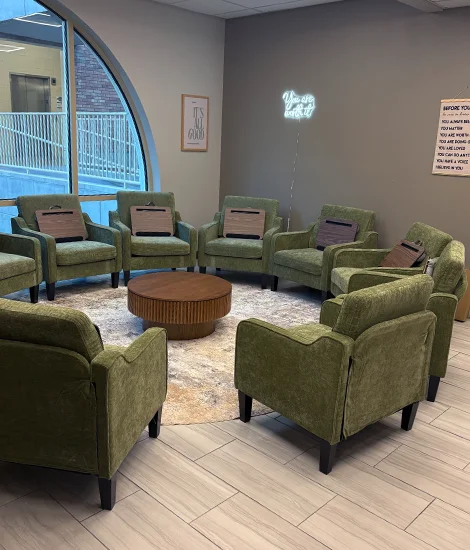
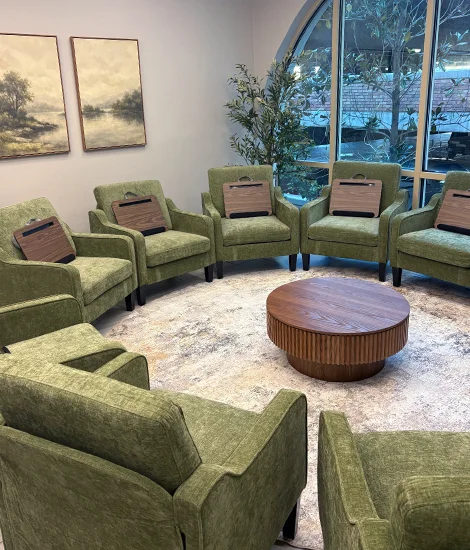
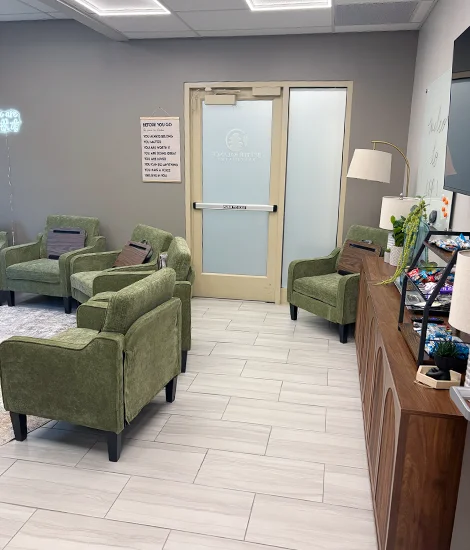
Yes. Join in person in St. George, or attend our virtual IOP from home in Cedar City. Every patient joins the same psychiatrist-led program, so you can choose the setting that makes it realistic to show up three evenings a week.
Join group sessions face to face at our downtown clinic, a short drive for patients across Washington County.
Skip the drive to St. George. With our virtual IOP, Cedar City patients attend the same evening sessions by secure video from home, with full access to our care team.
Live elsewhere in Utah? Virtual attendance may be an option for you as well. Let us know on your enrollment form.
Our adult IOP supports people whose symptoms need more than a weekly session but who are safe to remain at home.
Major depressive disorder, persistent depressive symptoms, and treatment-resistant depression that hasn't lifted with weekly care.
Depression careGeneralized anxiety, panic disorder, social anxiety, and anxiety that keeps interfering with work, sleep, or relationships.
Anxiety carePost-traumatic stress disorder and trauma-related symptoms, including trauma carried by veterans and first responders.
PTSD careBipolar depression and mood-cycling patterns that need close psychiatric oversight alongside therapy.
Bipolar careMental health conditions alongside substance use, addressed together rather than treated as separate problems.
Dual diagnosis careStructured step-down support after a hospitalization or acute crisis, so the progress you made holds.
Crisis stabilizationA psychiatrist confirms the right level of care at your evaluation. If IOP isn't the best match, we'll help you find what is, whether that's medication management, TMS, Spravato, standard outpatient therapy, or a higher level of care.
Mental health care exists on a spectrum. Knowing where an intensive outpatient program sits can help you and your provider make the right call.
| Level of Care | Time Commitment | Best For |
|---|---|---|
| Weekly therapy | 45 to 60 minutes, once per week | Stable symptoms, maintenance, personal growth work |
| Intensive Outpatient (IOP) | About 9 hours per week, 3 evenings | Symptoms that persist despite weekly care, step-down from crisis, dual diagnosis |
| Partial Hospitalization (PHP) | Full days, 5 days per week | Severe symptoms that fall short of needing overnight hospitalization |
| Inpatient | 24-hour hospital-based care | Acute crisis or immediate safety concerns |
If you're not sure which level fits, that's what the evaluation is for. Our psychiatrist can recommend the appropriate step and coordinate with other providers when needed.
Your treatment plan is directed by a board-certified psychiatrist, with medication management built in rather than handed off to another practice.
The region voted us Best Psychiatrist in 2023, a reflection of the trust patients and families place in our team.
Evening sessions, in person or virtual, mean you don't have to choose between getting help and keeping up with work and family.

Dr. Hendleman founded Better Balance Psychiatry to bring advanced, evidence-based care to southern Utah. He specializes in treatment-resistant depression, trauma in uniformed service members, and advanced treatments including TMS, Spravato, and IV ketamine.
Learn MoreKind words from our southern Utah community about the welcoming care we work hard to provide.
"The front staff are always super energized, upbeat, and welcoming. Kell is always on the go in the office making sure patients are taken care of while waiting for their appointment. The providers are respectful and caring."
"The staff at Better Balance in Cedar are always friendly and kind. Kale goes out of her way to make anyone feel welcome. The office staff are always ready to help and make you feel comfortable."
"The providers really know their stuff and make sure to check in with you often. The team is so good at making you feel comfortable and welcome. I'd highly recommend them to anyone seeking help with their mental health."
"Everyone I've worked with in the office is absolutely amazing. I've had a wonderful experience every time. They're great at helping you feel comfortable. Very grateful for their team."
Reviews reflect individual experiences with our practice and are not a guarantee of results. Always consult a professional about your mental health needs.
In many cases, yes. Insurance plans typically cover intensive outpatient programs when they're a medically necessary level of care. Our team verifies your specific benefits before your program begins so there are no surprises.
An IOP is a structured mental health treatment program you attend several days a week without being hospitalized. It sits between weekly therapy and inpatient care, giving you a higher level of support while you continue living at home.
Our IOP meets Monday, Wednesday, and Thursday evenings from 5 to 8 PM. Because sessions begin after typical work hours, most patients can attend without taking time off from their job.
About nine hours per week: three sessions of three hours each. That is enough structure to make real progress while leaving your days open for work, school, and family.
Length varies by patient. Most people attend for several weeks, though some benefit from a longer course of care. Your therapist reviews your progress regularly and adjusts the plan as your symptoms respond.
Yes. Our virtual IOP, sometimes called an online IOP, lets you join the same evening sessions by secure video. Sessions are also held in person at our St. George clinic. Virtual attendance is a good fit for Cedar City patients and anyone in Utah who lives too far to drive in three evenings a week. Your care team confirms the best format during your evaluation.
Yes. Cedar City patients join the same evening IOP virtually, which saves close to an hour of driving each way. Our Cedar City office at 444 S Main St, Suite A4, remains available for in-person appointments outside of IOP.
Our IOP supports depression, anxiety, PTSD, bipolar disorder, dual diagnosis (mental health with substance use), and post-crisis stabilization. A psychiatrist confirms the right level of care during your evaluation.
IOP typically runs about three hours a day, three days a week. PHP (partial hospitalization) is a full-day program, five days a week. PHP is a higher level of care for more severe symptoms that still do not require overnight hospitalization.
In many cases, yes, when IOP is medically necessary. We work with Aetna, Regence Blue Cross Blue Shield, Cigna, Medicaid, Molina, and Optum, with TriWest pending, along with other plans. We verify your specific benefits before you begin so you understand any expected cost.
Complete the IOP enrollment form on this page. Our team verifies your insurance benefits, then schedules a psychiatric evaluation with a member of our psychiatry team to confirm IOP is the right fit for you. No referral is required.
In most cases, yes. Our IOP meets in the evening specifically so you can keep up with work, school, and family responsibilities during the day.
Your care stays coordinated under one roof. If another approach is a better fit, your psychiatrist can help you get there.
Your enrollment form is the first step. Our team verifies your insurance and schedules a confidential evaluation to confirm IOP is the right fit. No referral required.
In-person IOP in St. George · Virtual attendance for Cedar City patients